If you’ve ever driven along a rural road or hiked past a utility pole strung with power lines, you’ve probably glanced at the small, curved components holding those wires in place—those are shackle insulators. As a shackle insulator supplier, I get asked all the time: “Where exactly are these things installed, and why not use the ones I’ve seen on tall transmission towers?” The truth is, shackle insulators aren’t built for high-voltage cross-country lines. They serve a specific, critical role in electrical distribution systems, and knowing where they go can help anyone in the industry—from line crew leads to project managers—make better decisions about their material choices. Let’s break this down, with real-world examples I’ve seen in my years working with utilities across North America, and why shackle insulators matter more than many people realize. Shackle Insulators
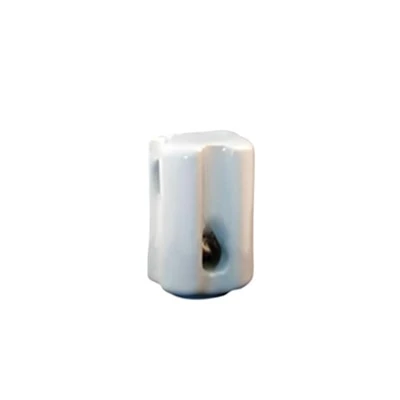
First, let’s start with the basics for anyone who might be new to this: shackle insulators are low-to-medium voltage devices designed to anchor power lines to structural components, while also preventing electricity from leaking into the pole or the ground. Unlike suspension insulators (the long, chain-like ones on transmission towers for 110kV and higher), shackle insulators are compact, usually made of ceramic or polymer, and shaped like a U or a curved bowl. They’re mounted flat, not hanging down, which is why their installation spots are very specific. The most common place you’ll find them is on overhead distribution lines, which carry power from local substations to homes, businesses, and farms. Distribution lines typically operate between 2.4kV and 34.5kV—way lower than transmission lines, so they don’t need the heavy-duty insulation of suspension insulators.
Let’s talk about the first primary installation spot: secondary overhead power lines, the ones you see running along residential streets, neighborhood utility poles. I remember a project last year with a municipal utility in Ohio that was upgrading its residential line system. Their old lines used generic pin insulators, but after heavy ice storms the winter before, a dozen pins cracked and caused outages. We recommended swapping some out for shackle insulators, and the installation crew told me it was way easier. Shackle insulators are mounted to a steel shackle bolt, which clamps directly to the crossarm of the pole—no drilling extra holes or adjusting the crossarm angle, like with pin insulators. On residential secondary lines, which usually carry 120/240V for single-family homes, the shackle insulators are installed at every pole where the line turns, branches, or connects to a service drop—the wire that runs from the pole to a house. That service drop is a key spot: the shackle insulator holds the service wire tight to the pole, so it doesn’t sag too close to the ground or to tree branches, and it keeps the electrical current from flowing into the pole’s wood or metal crossarm. If you’re driving through a subdivision, look for the small, round insulators at the base of the wire where it hooks to the pole—9 times out of 10, that’s a shackle insulator.
Another big spot: rural distribution lines, especially lines that run along farm roads or through open agricultural land. I’ve worked with dozens of farm co-ops that rely on shackle insulators for their off-grid and near-grid lines. Rural lines are often shorter, run fewer miles than transmission lines, and have to handle more turns and connections to farm buildings—like grain elevators, irrigation pumps, and barns. A few years ago, a corn farm in Iowa had a problem: their irrigation pump line kept getting damaged by heavy wind, because the line was strung too loose and bounced into the pole. We sent our team to install heavy-duty polymer shackle insulators at every 100 feet along that stretch, and they also mounted extra shackles at the points where the line connected to the pump’s power box. The shackle’s curved shape gives the line more grip, so it doesn’t slip or sag, which is perfect for the uneven terrain and variable weather in farm areas. Unlike ceramic shackle insulators, which can crack from freezing temperatures or impacts from falling tree limbs, polymer ones are UV-resistant and shatterproof, which is why they’re so popular for rural sites. I’ve also seen shackle insulators used in areas with high humidity, like the Southeast U.S.—they’re sealed to prevent moisture from getting inside, which stops electrical leakage that can cause power loss.
Now, what about places you might not expect? Underbuilds and low-voltage branch lines, right below transmission lines that run through urban or suburban areas. Many cities don’t have space to bury all their power lines, so they string secondary lines right below the high-voltage transmission towers. Those secondary lines use shackle insulators because they need to be mounted low, close to the crossarm, to avoid interfering with the transmission lines above. If they used suspension insulators, the lines would hang too low, which is a safety hazard. A utility in Chicago recently told me that they updated 30 miles of underbuild lines with polymer shackle insulators last year, because the old ceramic ones were chipping from debris falling off the transmission towers. The shackles mount flush, so they don’t stick out and get damaged by that falling debris, and their insulation is rated for the low voltage of the secondary lines.
Wait, let’s address a common misconception: some people think shackle insulators are only for wood poles, but that’s not true. We supply a lot of shackle insulators for steel poles, concrete poles, and even fiberglass utility structures, which are used in coastal areas or areas with termite problems. For steel poles, the shackle insulator is mounted to a steel bracket that’s bolted to the pole, and the insulator separates the energized line from the steel pole (which would otherwise conduct electricity). In Florida, where many coastal utilities use steel poles to resist saltwater damage, shackle insulators are standard on all distribution line connections. Salt air can corrode metal, but the insulator creates a barrier, so the current stays in the line where it’s supposed to. We also supply shackle insulators for temporary power lines, like for construction sites, outdoor festivals, or disaster relief. Those temporary lines need to be quick to install and remove, and shackle insulators bolt on in minutes without permanent modifications to poles. I remember after a hurricane hit Texas a couple years ago, we shipped hundreds of polymer shackle insulators to a relief team that was setting up temporary power for shelters. They were able to mount the lines to existing wooden poles in hours, instead of waiting for specialized equipment, which helped get power to 2,000 families faster.
Now, let’s talk about where you wouldn’t install a shackle insulator, because that’s just as important as where you would. They’re not for high-voltage transmission lines (anything over 35kV—those need suspension insulators that can handle the higher electrical stress). They also aren’t for lines that go through areas with very heavy mechanical load, like long spans between poles with no turns, because shackle insulators are designed for anchoring, not just hanging. If you have a span over 500 feet, you need a suspension insulator to take the weight, not a shackle. And they’re not used on buried lines, obviously—those use different types of insulation, like underground cables with built-in insulation.
As a shackle insulator supplier, I see first-hand how choosing the right insulator for the right spot makes all the difference in reliability. I’ve had utilities tell me that switching to the right shackle insulator cut their outage time by 40% in areas with bad weather, because the insulators don’t crack or slip like old ones. I’ve also had construction teams say that the quick installation of shackle insulators saved them thousands of dollars in labor costs for temporary power setups. The key takeaway is that shackle insulators are workhorses for low-to-medium voltage lines, in spots where you need to anchor lines, make turns, connect to service drops, or work with different pole materials. They’re not flashy, but they’re essential for keeping power flowing to places where people need it most.

If you’re working on a project and need help figuring out whether a shackle insulator is right for your installation, or you’re ready to source high-quality insulators for your utility or construction project, don’t hesitate to reach out for a consultation and pricing. We work with small farm co-ops, large municipal utilities, and contractors across the country, and we’re happy to help you pick the right product for your specific needs, no matter how big or small the job is.
Glass Suspension Insulators References
- American National Standards Institute (ANSI) C29.1-2017, Test Methods for Ceramic Insulators for Overhead Lines
- Institute of Electrical and Electronics Engineers (IEEE) Standard 1230-2015, Guide for the Application of Insulators for Overhead Distribution Lines
- National Electrical Safety Code (NESC) 2023, Part 2: Overhead Lines
Chongqing Pigeon Porcelain Insulator Co., Ltd.
As one of the most professional shackle insulators manufacturers and suppliers in China, our products have good reputation in the market. Please feel free to buy durable shackle insulators at competitive price from our factory. Good service and quality products are available.
Address: No.10, Hequan North 1st Road, Yanjia Industrial Park, Changshou District, Chongqing, China
E-mail: cqdc2006@163.com
WebSite: https://www.gpdcinsulators.com/
