If you’ve ever worked with portable electronics, power tools, or electric two-wheelers, chances are you’ve come across 14500 cylindrical lithium batteries. As a supplier of these compact, high-performance cells, one of the most common questions I get from engineers, product designers, and hobbyists alike is: “What’s the internal resistance of a 14500 cylindrical lithium battery?” It’s not a trivial question—internal resistance directly impacts performance, safety, and how reliably a battery works in real-world applications. Today, I’m breaking this down from both a practical supplier’s perspective and a technical standpoint, so you’ll have a clear, accurate picture of what to expect. Cylindrical 14500 Lithium Battery
First, let’s define what internal resistance actually is. In simple terms, internal resistance (IR) is the total opposition that a battery’s components—electrodes, electrolyte, separator, and current collectors—exert to the flow of electric current. Unlike the external resistance of a circuit, this is an inherent property of the battery itself, measured in milliohms (mΩ) because it’s very low, not ohms. It’s not a static number either; it changes based on factors like state of charge (SoC), temperature, discharge rate, age, and even how the cell was manufactured. That’s why as a supplier, we can’t give you a one-size-fits-all number—we can give you ranges based on standard cell specifications, and explain what causes variations.
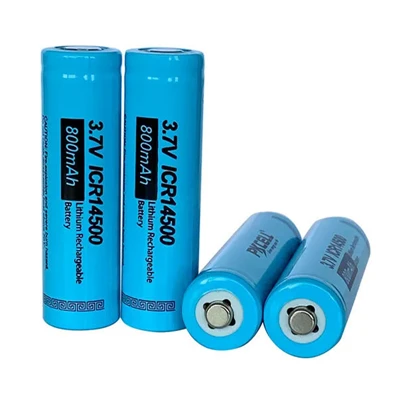
So, what’s the typical internal resistance for a standard 14500 lithium ion cell? The 14500 is a popular size, often described as an AA-sized lithium cell, with a diameter of 14mm and a length of 50mm. Most 14500 cells are 3.7V nominal, 3.2V for lithium iron phosphate (LiFePO4) variants, and rated for capacities between 600mAh and 1000mAh. For conventional 3.7V cobalt-based (LiCoO2) 14500 cells, internal resistance usually falls between 80 mΩ and 150 mΩ when brand new, at room temperature (25°C/77°F), and at 50% state of charge. LiFePO4 14500 cells, which are more common in low-drain, high-safety applications, tend to have slightly higher IR, ranging from 120 mΩ to 180 mΩ for new cells.
But here’s where it gets nuanced: this range varies a lot depending on the cell’s design and intended use. High-drain 14500 cells, built for applications like power tools or flashlights that need high current bursts, have lower internal resistance—often as low as 60 mΩ to 90 mΩ. That’s because they use thicker current collectors, higher-quality electrolyte, and optimized electrode architectures to minimize resistance. On the flip side, low-drain 14500 cells for devices like remotes or small sensors might have higher IR, up to 180 mΩ, since they’re designed for steady, low current draw rather than high pulses.
As a supplier, we test every batch of 14500 cells for internal resistance before they leave our facility, and we always emphasize how critical it is to test under conditions that match your application. A lot of customers come to us saying, “My multimeter read 50 mΩ for a 14500 cell,” and that doesn’t align with our specs—wait, no, that’s a common mistake. Many cheap multimeters measure IR using a small test current (like 1mA), which only captures a tiny portion of the total resistance. The standard way to measure a battery’s real-world internal resistance is using a load test: you apply a moderate discharge current (usually 0.2C to 1C for 14500 cells, meaning 120mA to 1A for a 600mAh cell, 200mA to 1A for a 1000mAh cell) and calculate IR from the voltage drop during discharge (IR = ΔV / I). That gives you a number that reflects how the battery will actually perform under load, not just idle conditions.
Now, let’s talk about what affects internal resistance, because this changes over the life of a cell, and it’s a key factor in battery performance. Temperature is a big one. Cold temperatures increase internal resistance drastically. A 14500 cell at 0°C (32°F) can have 20-50% higher IR than at room temperature, and at -20°C (-4°F), IR can double or triple. That’s why devices in cold climates often have shorter run times—they’re fighting higher internal resistance, which wastes energy as heat instead of powering the device. Conversely, high temperatures (above 45°C/113°F) can lower IR temporarily, but excessive heat accelerates degradation, so it’s not a good trade-off.
State of charge also plays a role. For most lithium chemistries, internal resistance is lowest around 50% SoC. When a cell is fully charged, IR increases slightly, and when it’s deeply discharged, IR rises more sharply. For example, a 14500 LiCoO2 cell at 100% SoC might have an IR of 100 mΩ, drop to 85 mΩ at 50% SoC, and jump to 130 mΩ at 10% SoC. That’s important because running a battery too low (below 2.5V per cell for LiCoO2, 2.0V for LiFePO4) can not only damage the cell but also lead to sudden voltage drops, since the high IR at low SoC can’t supply enough current.
Age and cycle life are another big factor. As a 14500 lithium battery goes through charge and discharge cycles, the internal resistance gradually increases. Every cycle causes small amounts of degradation: solid electrolyte interphase (SEI) layers thicken, electrode materials crack, and electrolyte breaks down. A brand new 14500 cell might have 100 mΩ IR, after 300 cycles that number could jump to 150 mΩ, and after 500 cycles, it might be 200 mΩ or higher. That’s the point where the battery is reaching the end of its useful life—run time drops, and it can’t supply the current it was designed for. We always advise customers to factor in this degradation when specifying 14500 cells for long-life applications, building a 20-30% buffer for expected IR increase over time.
Now, why does internal resistance matter for your application? Let’s use a couple of examples to make this concrete. If you’re building a high-power LED flashlight that uses 14500 cells, you need low IR (under 100 mΩ) to supply the 2A or 3A current needed for maximum brightness. A cell with high IR would have a large voltage drop under that load, making the flashlight dimmer, and might even overheat as energy is wasted inside the battery. For a remote control that uses a 14500 cell to power a small microcontroller, you don’t need low IR—steady, low current is fine, so a higher IR cell is a more cost-effective choice. For electric scooters or small power tools that cycle between high and low current, mid-range IR (100-120 mΩ) is the sweet spot, balancing performance and cost.
As a 14500 lithium battery supplier, we see a lot of customers who underestimate IR, leading to product failures. Last year, a customer building a portable drone came to us with a prototype that was only lasting 15 minutes on a single 14500 cell. They had picked cells based on capacity alone, not realizing their application needed high-drain cells with lower IR. We supplied cells with 80 mΩ IR instead of their original 140 mΩ, and run time jumped to 25 minutes, with no overheating issues. That’s a common scenario: internal resistance is just as important as capacity and voltage when choosing a battery.
It’s also worth noting that not all 14500 cells are created equal. Cheap, unbranded cells from unknown manufacturers often have inconsistent internal resistance, and they might overstate their capacity to cut costs. For example, a low-quality 14500 cell advertised as 1000mAh could actually have a lower real capacity, and its IR might be 200 mΩ or higher—meaning it can’t supply the current you need, and it degrades much faster than a reputable cell. That’s why working with a reliable supplier matters: we source cells with consistent specs, test every batch for IR, and provide data sheets that list IR at standard conditions, so you can design with confidence.
If you’re designing a product that uses 14500 cylindrical lithium batteries, here are a few practical tips from our team. First, specify the IR range you need: for high-drain applications, ask for cells with maximum IR of 100 mΩ; for low-drain, 150 mΩ is acceptable. Second, test your cells under real load conditions, not just idle or low current tests. Third, account for temperature and degradation: if your product will be used in cold environments, choose a high-drain cell with inherently low IR to offset cold-related increases. Fourth, don’t prioritize cost over consistent specs—cheap cells often lead to higher long-term costs from product returns or replacements.
At the end of the day, the internal resistance of a 14500 cylindrical lithium battery isn’t a random number—it’s a key performance metric that ties to your product’s reliability, run time, and safety. Whether you’re a hobbyist building a custom gadget or an engineer designing a commercial device, getting this right makes all the difference.

If you’re sourcing 14500 lithium batteries for your project and need accurate spec data, batch testing, or customized solutions tailored to your application’s performance needs, our team is here to help. We can provide detailed datasheets, sample cells for testing, and guidance on selecting the right IR range for your design. Reach out to our sales team today to discuss your requirements and get a quote that fits your needs.
Cylindrical Battery Pack References
- Lithium-Ion Battery Internal Resistance Measurement Principles; National Renewable Energy Laboratory, U.S. Department of Energy
- Cylindrical Lithium Ion Cell Design and Performance Characteristics; Journal of Power Sources, 2021, Volume 498
- Effects of Temperature and State of Charge on Lithium Battery Internal Resistance; Battery University, 2022
- Cycle Degradation in Commercial 14500 Lithium Cells; IEEE Transactions on Energy Conversion, 2020, Volume 35
Shandong Dingshengyuan Electronic Technology Development Co., Ltd.
As one of the most professional cylindrical 14500 lithium battery manufacturers and suppliers in China, we’re featured by quality products and good service. Please rest assured to buy advanced cylindrical 14500 lithium battery made in China here from our factory. Contact us for more details.
Address: Building 3, Shanhaitian Intelligent Manufacturing Industrial Park, No. 1639 Beihai Road, Liangcheng Subdistrict, Shanhaitian Tourist Resort, Rizhao City, Shandong Province
E-mail: DSY18663388293@outlook.com
WebSite: https://www.dsybattery.com/
