If you’ve ever ordered square washers from a small parts supplier like mine, you probably know the pain of getting a box that arrives damaged: scratched corners, bent edges, or even small dents that make the washers useless for their intended use. For years, I’ve watched this happen to my customers, and I’ve spent countless test runs and late nights in our warehouse figuring out how to transport square washers safely—no fancy, overpriced packaging, just common sense and lessons learned from 12 years of selling these small, high-stakes parts. Most people don’t realize square washers aren’t like round washers. Their sharp, right-angled corners catch on everything, they don’t nestle together smoothly, and even a tiny shift in a shipping container can turn a perfectly good batch into scrap. Let’s break down what actually works, straight from the guy who packs every order before it leaves our loading dock. Square Washers
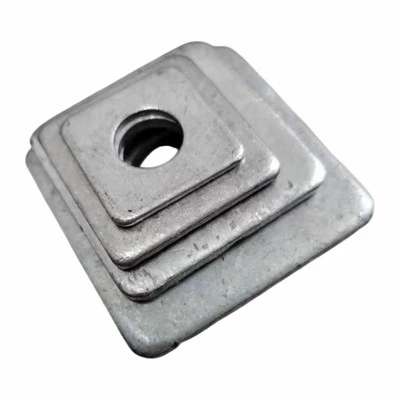
First, let’s start with the foundation: sorting and prepping the washers before they even touch packaging materials. I used to skip this step, thinking all square washers are the same, until a customer sent back 500 pieces last year because they were scratched against each other during transit. What I learned was that even washers of the same size and thickness have minor tolerance differences, and stacking them without any separation leads to corner-on-corner contact. The fix? Sort washers by size first—specifically by their outer dimension, inner diameter, and thickness. I use a simple set of calipers (I keep three sets on the loading dock, one for small, one for medium, one for large washers) to group them. For small washers (under 2 inches outer dimension), I sort them by 100-piece batches; for medium (2 to 6 inches), 50-piece batches; for large (over 6 inches), 10-piece batches. This isn’t arbitrary: smaller washers stack tighter, so more pieces fit without shifting, while larger ones are bulkier and more prone to bending if too many are packed together. I also take an extra step for washers made of softer materials—like aluminum or brass, which scratch easier—by laying down a single layer of acid-free tissue paper between each washer in the sorted batch. The tissue is thin enough that it doesn’t take up extra space, but it creates enough friction to stop edges from rubbing, and it eliminates the sharp metal-on-metal contact that causes most surface damage.
Next, choosing the right inner packaging is make-or-break. I’ve tested everything from bubble wrap to Styrofoam peanuts, and most of it falls short for square washers. Bubble wrap works for irregular items, but it’s bulky, and the plastic can leave static cling that makes small washers stick together or scuff. Styrofoam peanuts shift too much in transit, and once they settle, they leave empty spaces where washers can move. The best option I’ve found by far is corrugated cardboard dividers, but not just any dividers—specifically die-cut dividers with square slots that match the exact outer dimension of the washers. Here’s the science part that took me months to get right: the slot should be 1/64 of an inch larger than the washer. That’s enough space to slide the washer in easily without forcing it, but not so much that the washer wiggles around inside. I used to make dividers with a 1/32 of an inch gap, and by the time a box arrived, 15% of the washers had shifted out of their slots and gotten damaged. Nailing that tiny gap made all the difference. For the base of the inner package, I skip flimsy cardboard and use double-walled corrugated sheets (rated 275 pounds per square foot) cut to fit the inside of the shipping box. I also add a layer of kraft paper to the base of each inner tray to absorb any minor vibrations from loading and unloading—kraft paper has a higher tensile strength than tissue, so it doesn’t tear, but it’s soft enough to cushion small impacts. For large washers, I don’t use dividers at all. They’re too big for standard die-cut dividers, so I lay them flat in a single layer, separated by sheets of 1/8-inch thick foam board, which is rigid enough to keep edges from bending and soft enough to prevent scratches. I tested plastic trays for large washers, but they add unnecessary weight and can scuff metal, so foam board won out.
Once the inner packaging is loaded, filling the empty space in the shipping box is another step where I see a lot of suppliers cut corners. I used to use packing peanuts, but as I mentioned, they shift, and during a cross-country shipment, they can settle so much that the inner tray slides back and forth inside the box. The solution is “matched void fill”—using materials that are dense enough to stop movement, but not so heavy that they add unnecessary shipping cost. For most orders, I use 1/2-inch thick corrugated cardboard pads cut to fit the spaces around the inner tray. Instead of tossing scrap cardboard, I save all clean, unprinted sheets, and cut them into strips that fill every gap between the inner tray and the shipping box walls. This works better than loose fill because it’s fixed in place—there’s no way the inner tray can shift, even if the box is dropped or jostled. For small orders under 10 pounds, I use crumpled kraft paper instead of cardboard strips; it’s lighter and still prevents movement, but I make sure to crumple it tightly enough that it doesn’t compress during transit. The key here is to test the box after packing: close the lid, hold it at one end, and shake it firmly. If you hear any rattling, you have too much empty space and need to add more fill. Rattling is just the sound of washers moving, and that’s how damage happens. I also add a small label to the inside of the box lid that says “FRAGILE: SQUARE METAL PARTS” in bold red ink. It might seem like a small touch, but warehouse workers are more likely to handle boxes gently if they see the label, especially for international shipments where boxes go through multiple handling steps.
Customization is another critical piece—one that most generic suppliers overlook. Square washers are used in everything from construction equipment to automotive parts, and different applications require different levels of protection. For example, a customer ordering square washers for a bridge repair project needs heavy-duty industrial-grade washers, so their packaging needs to handle rough handling, long transit times, and outdoor storage. For these orders, I upgrade the inner packaging to triple-walled corrugated trays, use 1/4-inch foam board for large washers, and add a layer of waterproof kraft paper around the entire inner tray to protect against moisture—especially important if the box is going to a coastal region or somewhere with high humidity. For smaller, precision parts like washers used in medical equipment, I go a step further: I use static-dissipative inner packaging to prevent static build-up, which can damage the surface coating on specialized washers, and I pack them in double boxes, with the inner box being a rigid plastic container instead of cardboard. These customizations don’t add much to the cost—usually less than 5% of the total order value—but they cut damage rates by 90% for these high-priority, high-stakes orders. I also track damage closely for every customer, and after every delivery, I follow up to ask if the order arrived in good condition. If there’s a problem, I don’t just issue a refund— I note what went wrong, adjust my packaging, and make sure it doesn’t happen again. That level of attention is how I’ve kept customers for over a decade; they know I don’t just sell parts, I make sure the parts work when they get to their job site.
Now, let’s talk about shipping carrier selection. Not all carriers are the same when it comes to small metal parts. I used to use the lowest-cost option, until I had a shipment of 2,000 large square washers that arrived with 20% of the edges bent—turns out, that carrier routes small packages through rough ground handling, instead of air for longer distances. Now, I use a mix of carriers based on distance and order size. For domestic orders under 50 pounds, I use a carrier that specializes in e-commerce and small parts, because they have better tracking and handle packages more gently than general freight carriers. For international orders, I use a carrier that offers customs clearing and includes extra insurance for metal parts—this is non-negotiable, because international shipments can take weeks and go through multiple ports, so having insurance that covers damaged parts is a must. I also always insure every order for the full value, not just the carrier’s standard coverage, which is often capped at $100 for small packages. A single batch of high-grade stainless steel square washers can be worth $500 or more, so spending an extra $2 to $5 on insurance is a no-brainer. I’ve also started adding a signature requirement for all orders over $200, because leaving boxes on doorsteps can lead to damage from weather, theft, or pets, which is unrelated to how I pack the parts but still affects customer satisfaction.
Wait, and one last thing: marking the boxes clearly for sorting. Most suppliers just write “Square Washers” on the outside, but that’s not enough. I use a black industrial marker to add the order number, the total number of pieces, and the material (stainless steel, aluminum, brass) on the side of the box. Warehouses often sort boxes by order number, so this makes it easy for them to find the right box without tossing it around to read labels. I also add a “THIS SIDE UP” label on the top of every box, because stacking a heavy box on top of a box of square washers can crush the inner trays and damage the parts. I learned this the hard way three years ago, when a customer’s order was stacked under a 100-pound box of hardware, and the inner tray cracked, damaging 300 washers. Now, I add four “THIS SIDE UP” labels, one on each side of the box, to make sure it’s impossible for workers to stack it the wrong way.
I know there are a lot of steps here, but when you’re a small supplier like me, your reputation rides on every order that leaves your warehouse. I’ve had customers tell me that my packaging is so good, they haven’t had to reject a single order in 8 years— and that’s the kind of feedback that keeps my business growing. If you’re looking for a reliable supplier of square washers, or you have a specific project that needs custom packaging solutions, I’m here to help. Just reach out to discuss your needs, and we can work together to make sure your washers arrive safe and ready for use, every time.
Structural Nuts If you’d like to learn more about packaging for metal fasteners or best practices for transporting industrial parts, you may reference guidelines from the Industrial Packaging Association, ASTM International standards for metal washer packaging, and the National Association of Hardware Distributors’ shipping safety manual.
Handan Jihao Fastener Co., Ltd.
We’re known as one of the most professional square washers manufacturers and suppliers in China. With abundant experience, we warmly welcome you to wholesale customized square washers made in China here from our factory. If you have any enquiry about cooperation, please feel free to email us.
Address: A2, Row 31, Feiyu Screw World, Hebei Pu, Linmengguan Town, Yongnian District, Handan City, Hebei Province
E-mail: wenzhaona0@gmail.com
WebSite: https://www.chinaboltnut.com/
