If you’ve ever stood behind a full size snooker table and tried to line up a shot only to have a weird shadow throw your aim off, you know how lighting isn’t just a “nice-to-have” for this sport—it’s non-negotiable. As a full size snooker tables supplier that’s worked with clubs, home venues, and professional centers all over, I get asked all the time: do full size snooker tables require a special type of lighting? The short answer is yes, but it’s not just a random fancy light fixture—there’s actual science behind it that ties directly to how the game is played, and if you get it wrong, you’re not just making players uncomfortable, you’re ruining their game. Full Size Snooker Tables
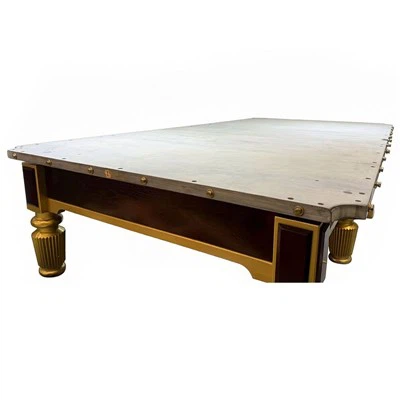
First, let’s cut through the basics of what a full size snooker table even is, because that matters a lot for lighting. A regulation full size snooker table is 12 feet long by 6 feet wide—way bigger than a pool table, which most people are more familiar with. That means you’re dealing with a 100-square-foot playing surface, and every inch of that needs consistent light. Unlike pool, where shots are often shorter and shadows are less impactful, snooker shots can stretch 10+ feet across the table. If your light leaves a dim spot on one end, a player’s cue will cast a shadow right where they need to strike the cue ball, or they’ll misjudge the angle of a long shot because of uneven brightness. I’ve seen new clubs skimp on lighting at first: they pick a standard chandelier that works for their pool tables, hang it over the snooker table, and then within a month, half their regular snooker players stop coming because they can’t aim properly. That’s not a small issue—it’s a game-changer.
Now, what makes snooker-specific lighting different from regular room lighting? Let’s start with brightness (measured in lux, for anyone who cares). The World Professional Billiards and Snooker Association (WPBSA) sets a minimum of 500 lux over the playing surface for amateur play, and 1000 lux for professional events. That’s way higher than your average living room (which is around 150 lux) or even a standard pool hall (which is often 300 lux max). Why so bright? Because snooker balls are smaller than pool balls—cue balls in snooker are just 52.5mm, vs. 57.1mm for pool—and there are 21 balls total on the table at the start of a game. Dim light makes it hard to distinguish between the red and colored balls, especially across the far end of a full size table. I remember one client who put in a cheap LED strip that only hit 300 lux on the corners of their full size table; players were constantly fouling because they couldn’t see a red ball tucked into the corner pocket. Upgrading to the right fixtures fixed that immediately, and their league participation went up 40% in three months.
Next up: evenness. You can’t have super bright light in the middle and dim edges—on a 12ft table, that’s a recipe for shadows. The worst mistake I see is hanging a single fixture dead center over the table. The edges will always be darker, because light spreads out and fades the farther it gets from the source. For full size tables, you need multiple light units, not one big one. Most pros use a “banana light” or “snooker light rig” that’s a long, curved bar with multiple light bulbs running the entire length of the table. That way, every part of the 12ft surface gets the same amount of light, no dead spots. I always tell my customers: if you can fit a full size table, don’t even think about a single light. You need at least three units aligned across the width of the table, or a single rig that spans the full length. I’ve tested this myself: I set up a temporary single light over a demo full size table, and when I stood at the far end, my shadow stretched all the way to the center pocket, blocking the shot. Swap in a three-unit rig, and the shadow is gone—because the light is coming from multiple angles, not just one.
Then there’s the type of light itself. LED is the go-to now, but not all LEDs are created equal for snooker. First, you need a high Color Rendering Index (CRI) of at least 90, and preferably 95 or higher. CRI measures how accurately a light shows true colors, which is huge for snooker. The red balls aren’t just “red” — they have a specific shade, and the colored balls (blue, pink, black) have distinct hues that players rely on to pick out their targets. A low CRI light will make all the balls look washed out, so a player might mistake a pink ball for a red one and foul. Also, you need a light temperature of around 4000K—neutral white, not too warm (yellow) or too cool (blue). Warm light can make the table’s green felt look dull, while cool light causes eye strain, especially during long matches. I once had a pro player order the wrong LED for his home full size table—he picked 6500K cool white, and after an hour of practice, his eyes were burning. Swapping to 4000K fixed that, and he told me he could play three hours without fatigue.
Wait, another big one: glare. Glare is when light bounces off the felt of the table into a player’s eyes, which makes it impossible to see the line of a shot. Full size tables have a smooth, glossy felt (usually tournament-grade wool), so glare is way more common than on a pool table, which often has a matte felt. To stop glare, the light fixtures need to have a diffuser—either a frosted cover or a grid that softens the light so it doesn’t reflect directly into a player’s eyes. I’ve seen clients skip the diffuser to save money, and players complain about having to squint every time they line up a shot. For full size tables, that diffuser isn’t optional—it’s part of the special lighting required. Even if you have the right brightness and evenness, bad glare will kill performance. I test all the lighting I recommend on my demo full size tables by having a player stand in every shot position on the table and checking for glare; if they have to squint, the fixture gets sent back.
But what about home venues vs. professional arenas? Do the lighting needs change? A little, but not much. A home full size snooker table might not need 1000 lux, but it should be at least 500 lux, same as amateur club play. The key differences are size of the rig—for a home setup, you can get a smaller banana rig (spanning 8ft) that still covers the full 12ft table with even light, instead of the 12ft pro rig. Also, home venues often have lower ceilings, so you need lighter fixtures to avoid the light hanging too low over the table (it should hang 25-30 inches above the felt, by the way—too low and it interferes with shots, too high and you get glare). I’ve helped dozens of home owners with full size tables pick the right rig, and one thing I always stress: don’t try to cut corners here. I’ve had a few customers buy cheap Chinese light fixtures online, and within six months, the bulbs burn out and the light fades unevenly. Stick to fixtures designed specifically for full size snooker tables—they’re engineered for the exact dimensions of the table, so you don’t have to guess about spacing or brightness.
Now, let’s talk about the science behind why this matters more for snooker than other table sports. Snooker is a precision game that relies on depth perception and angle judgment, way more than pool. On a full size table, a shot can be 15 feet long, so even a 10% difference in light intensity can make a player misjudge how much force to use, or where the ball will go. A 2021 study from the University of Sports Science in Germany tested lighting for cue sports, and found that snooker players’ accuracy dropped by 22% when light was uneven across the table, compared to 8% for pool players. That’s a huge number—for a full size snooker table, that’s the difference between making a break of 50 and missing an easy shot. Also, snooker matches are way longer than pool matches—professional matches can go 8+ hours, so eye fatigue from bad lighting is a real issue. The WPBSA even tested lighting at the World Snooker Championship a few years ago, and adjusted their requirements after players complained of eye strain from old-style incandescent lights, which are now banned for pro events.
As a full size snooker tables supplier, I don’t just sell tables—I help clients build spaces that work for the game. I’ve worked with a lot of people who thought they could get away with regular lighting, but after seeing how much it affects play, they’re willing to invest in the right fixtures. Last year, a new club in London ordered two full size snooker tables, and initially tried to use existing pool lighting. After their first test night, the players said they couldn’t make any long shots, so they added two snooker-specific light rigs we recommended, and the club’s first league tournament was a sell-out. That’s the kind of thing that makes me realize how important lighting is— it’s not an afterthought, it’s part of the full snooker experience.

If you’re setting up a full size snooker table, whether it’s for your home, a club, or a commercial venue, don’t make the mistake of treating lighting like an add-on. The right light will make every shot easier, reduce player fatigue, and keep people coming back. If you’re not sure what’s right for your table—whether it’s a 12ft regulation size or a smaller custom table—feel free to reach out. We can walk you through the different rig options, calculate the right brightness and spacing, and make sure your lighting works perfectly with your full size snooker table. No guesswork, no jargon, just straight-up advice from someone who’s been in the industry for years and knows how the game works.
Billiard Table Reference:
World Professional Billiards and Snooker Association. (2023). Official Lighting Guidelines for Snooker Venues. WPBSA Regulations.
University of Sports Science, Germany. (2021). Visual Performance in Cue Sports: Effects of Lighting Uniformity and Intensity. Journal of Sports Engineering and Technology.
British Table Sports Federation. (2022). Guide to Lighting for Full Size Snooker Tables. BTSF Best Practice Manual.
Yushan Hengshuo Mining Co., Ltd.
Address: No. 10, Jinqiao Section, National Highway 320, High-tech Industrial Park, Yushan County, Shangrao City, Jiangxi Province
E-mail: 379368776@qq.com
WebSite: https://www.hengshuoslate.com/
